
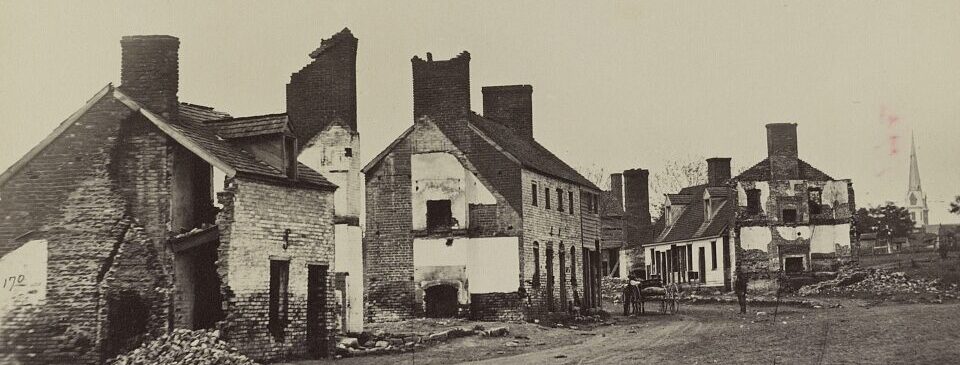
“Eyewitness to Battle: The Diary of Private McCarter” is a new narrative trail consisting of six Civil War Trails signs in Fredericksburg, Virginia. Installed in April 2026, the signs allow visitors to follow Union Pvt. William McCarter and the Irish Brigade the Battle of Fredericksburg – walking in their footsteps during their harrowing journey to battle and their doomed assault.
On the afternoon of December 13, 1862, during the Battle of Fredericksburg, 22-year old Union Pvt. William McCarter was lying wounded a short distance from the Confederates behind the stone wall at the base of Marye’s Heights, as torrents of rifle and cannon fire filled the air above him.
“My situation was truly an awful one,” he later wrote. “I was not more than 50 paces from a powerful, victorious foe – exposed to his three fires, left center and right… I laid disabled, disheartened, hope a mere shadow.”
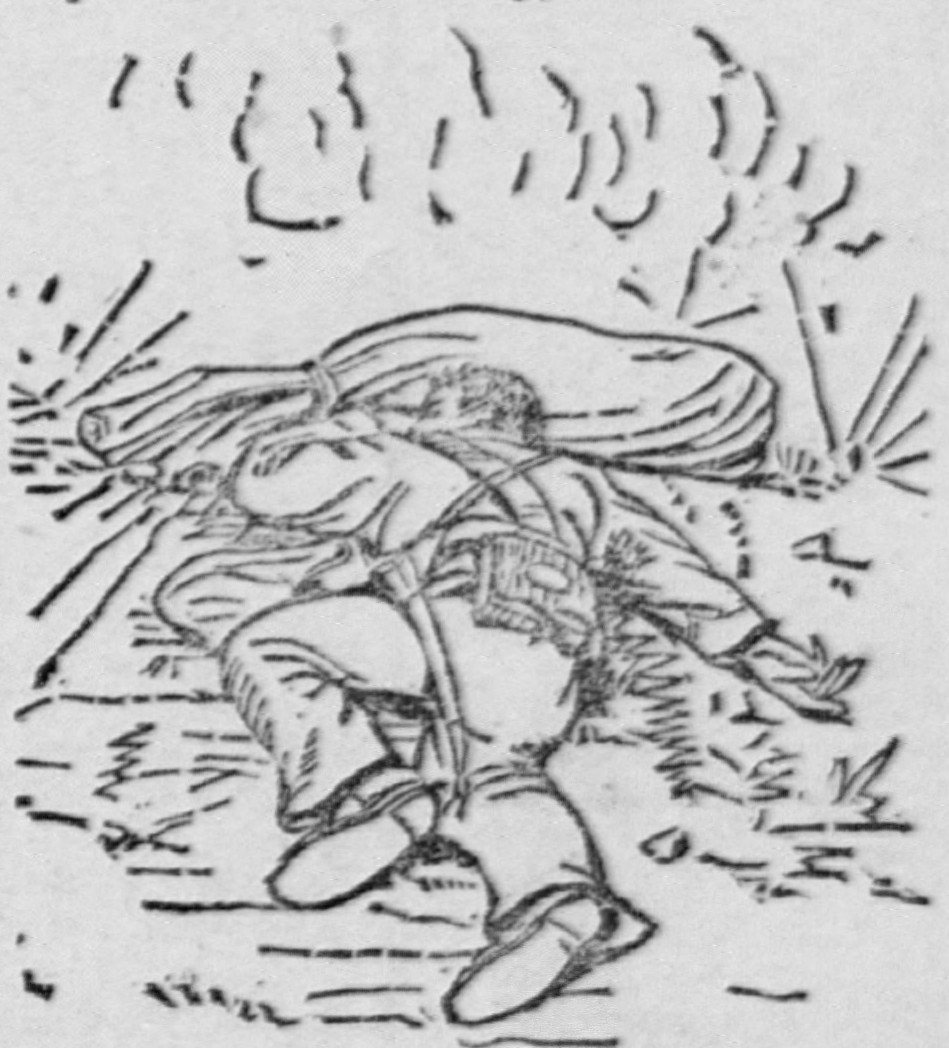
McCarter lying wounded at Fredericksburg. Illustration by Klem. From The National Tribune, July 29, 1886.
McCarter had been seriously wounded during the Irish Brigade’s attack. 50 paces from the wall, the brigade had been met with “a blinding fire of musketry.” Many fell, and the others stopped. As McCarter said, “It was simply madness to advance as far as we did and an utter impossibility to go further.” As the Federals stood and exchanged fire with the defenders, McCarter himself was hit by a bullet under his upraised arm, close to his shoulder. Faint and weak from loss of blood, he fell flat on his face.
When his consciousness returned, McCarter pressed as close to the ground as he could get, as the air above him was filled with “a deadly blizzard of shot, shell, and fire.” A newspaper reporter described the fire as “streams of jagged flame, writing and vibrating as if charged with electricity.” Additional Union attacks pressed forward, but the Confederate line erupted, and the men in blue “were blown back [by the fire] as if by the breath of hell’s door.”
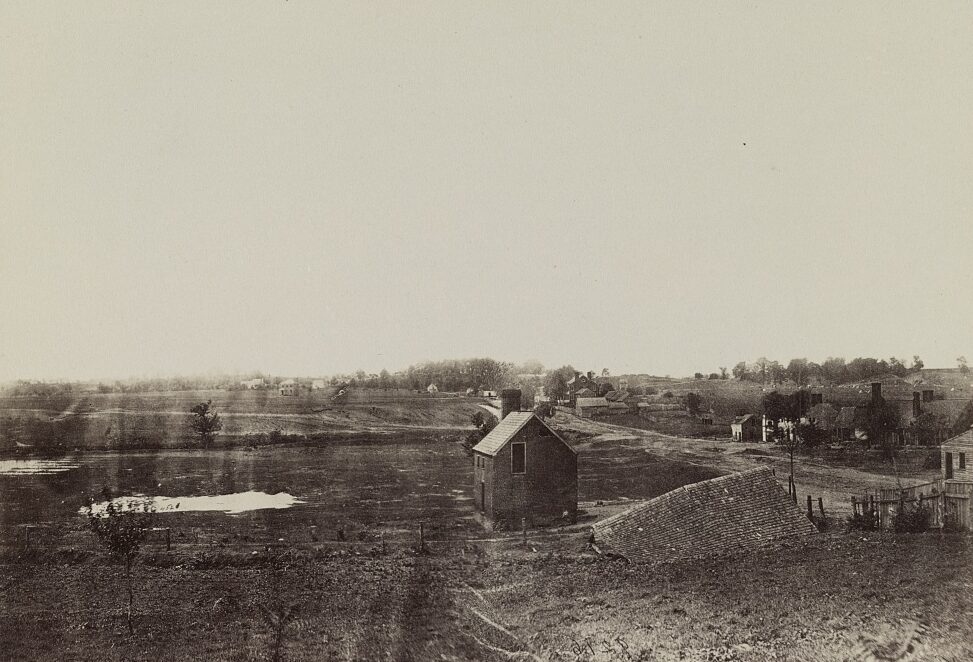
Ground crossed by the Irish Brigade, with the millrace in the middle distance. Courtesy Library of Congress.
“I never expected to get off that bloody field alive,” McCarter wrote.
Against the odds, McCarter survived the day, and he later wrote of his time in the Irish Brigade and his experiences during the battle. McCarter was a skilled and perceptive writer, and his remarkable account is filled with descriptive details that bring that terrible day to life. McCarter never formally published those memoirs, although the Philadelphia Weekly Times published excerpts of his story in 1883, as did the National Tribune in 1886. McCarter’s full account was finally published in 1996 as My Life in the Irish Brigade thanks to the work of Keven O’Brien, a historian of the brigade who edited the memoir for publication.
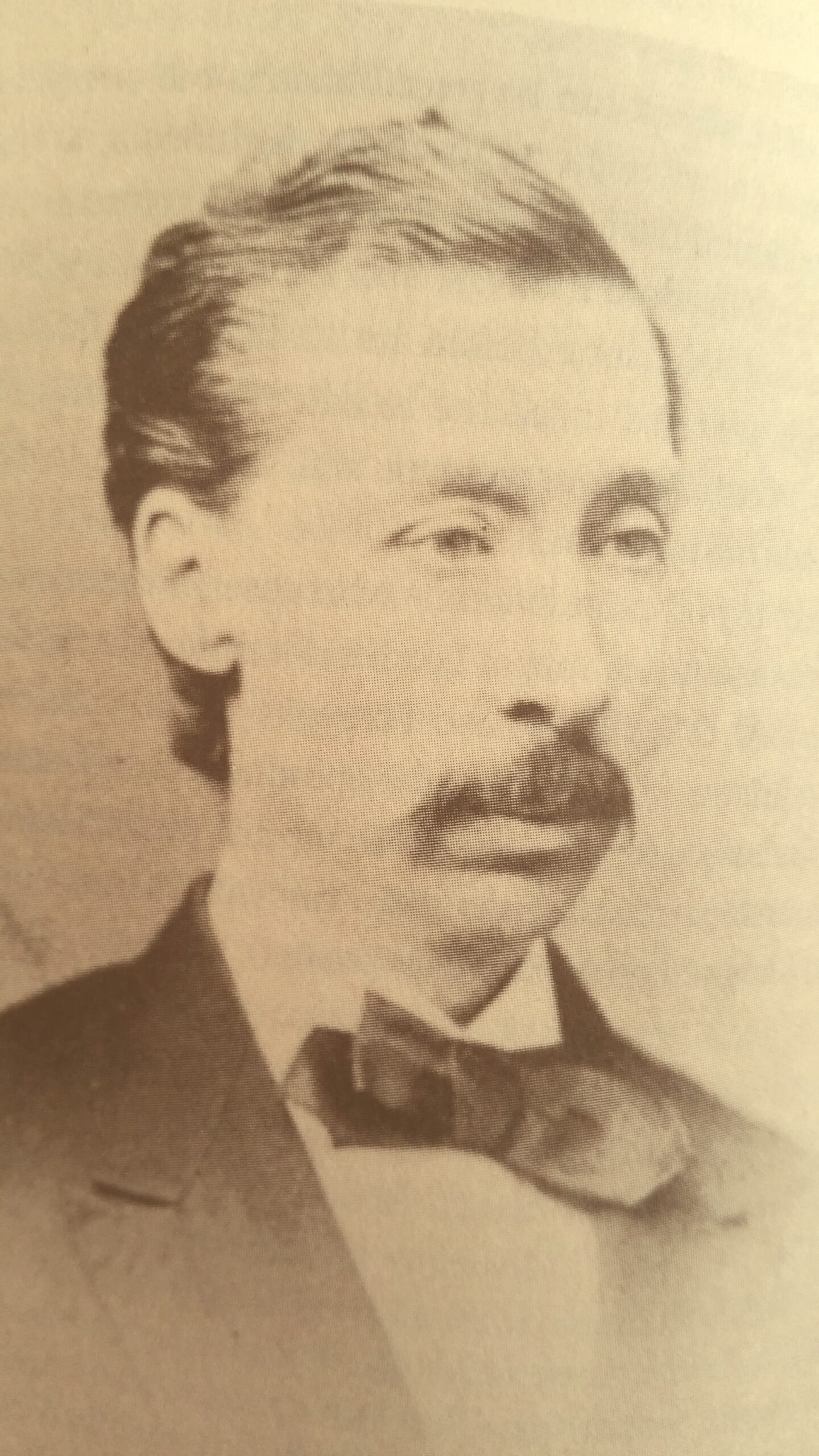
McCarter after the war. Courtesy Historical Society of Pennsylvania.
In 2024, our partners in Fredericksburg came to us with the idea of creating a multi-site trail through the city following the story of Private McCarter, incorporating excerpts from his diary. Our team worked alongside our partners to create a six-site trail for visitors entitled, “Eyewitness to Battle: The Diary of Private McCarter.”
The new signs, which feature a map to help visitors follow the trail as they visit the partner sites, include:
Part 1: City Dock: “Fall in” was the “death-knell”
(205 Sophia Street)
As the Irish Brigade fell in for battle, their commander, Gen. Thomas Meagher, distributed sprigs of boxwood to the men, a symbol of their Irish heritage, and a substitute for the battle-torn flag that had been shipped home for repair.
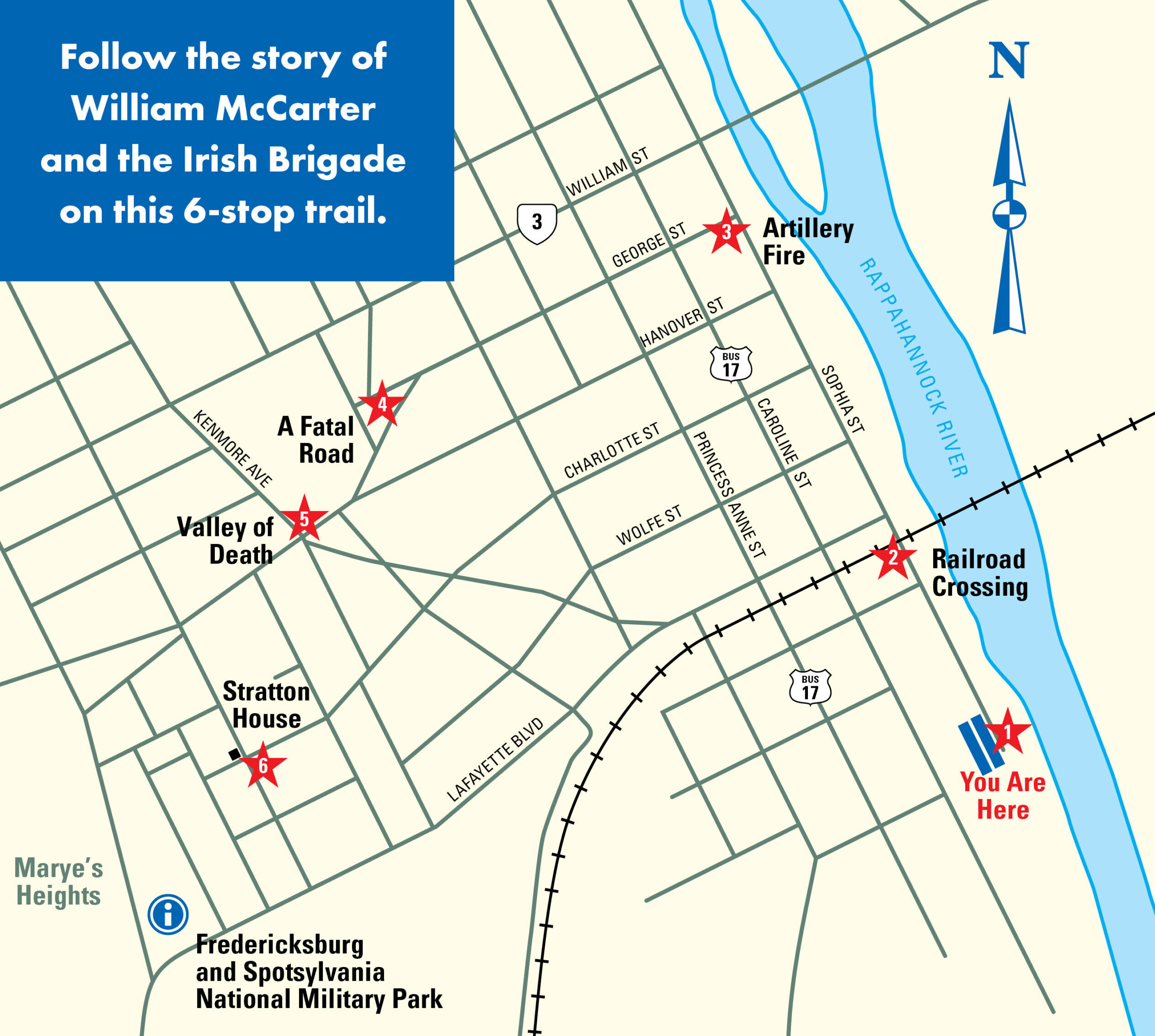
Map of tour locations from the first stop at City Dock.
Part 2: Railroad Crossing: “Oh, what fearful suspense”
(419 Sophia Street)
During their march through the city, on their way to the front, the brigade was occasionally forced to halt, increasing their anxiety and suspense. At the railroad tracks, they stopped to let wounded from the first attack pass by. The “fearful specimens of mangled humanity” were sobering and foreboding sights for those about to enter the battle.
Part 3: Artillery Fire: “Drawing blood quiet freely”
(102 George Street)
Whenever the brigade reached a cross street in the city, they became visible to the Confederate cannoneers on Marye’s Heights, who quickly opened fire. Near this sign’s location, a shell “as large as a flour barrel” exploded, wounding McCarter and seven other men and beheading a sergeant.
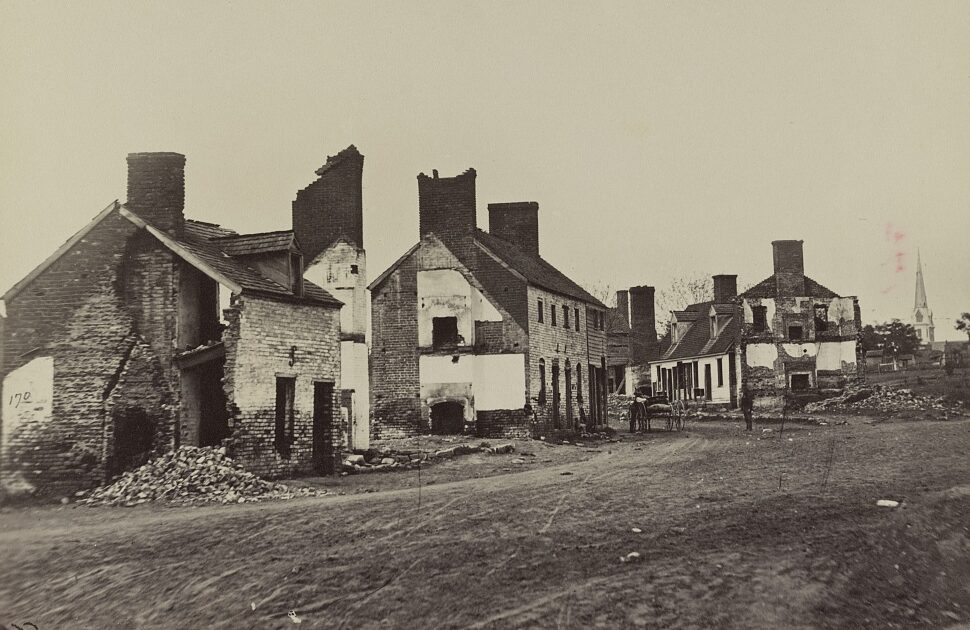
Damaged buildings on George Street. Courtesy Library of Congress.
Part 5: The Valley of Death: Into “The Valley of Death”
(649 Hanover Street)
Racing across the shell-swept ground, the brigade found its way blocked by a 15-foot-wide millrace in a narrow valley, the bridge having been destroyed by the Confederates. As artillery shells crashed down, the jammed-up men scrambled across, some wading through the frigid water, others using a makeshift bridge of trees.
Part 6: The Stratton House “The Rebels poured volley after volley into our faces”
(820 Mercer Street)
McCarter and the Irish Brigade swept around the Stratton House (which still stands today) and advanced at a run towards the Confederates behind the stone wall. Sheets of fire devastated their ranks, and McCarter himself fell wounded. Laying amidst his fallen comrades, he had a front row seat for the repeated and costly attacks that followed.
The new tour encourages visitors to follow the Irish Brigade’s eventful journey from the calm beginnings at the city docks to the storm-tossed climax near the Stratton House, with the story and battle building in intensity as they visit each site. And thanks to William McCarter’s illuminating first person accounts, the signs give visitors a “You Are There” sense of immediacy as they visit the places where history happened… and remember the men, in blue and gray, who lived through that day.
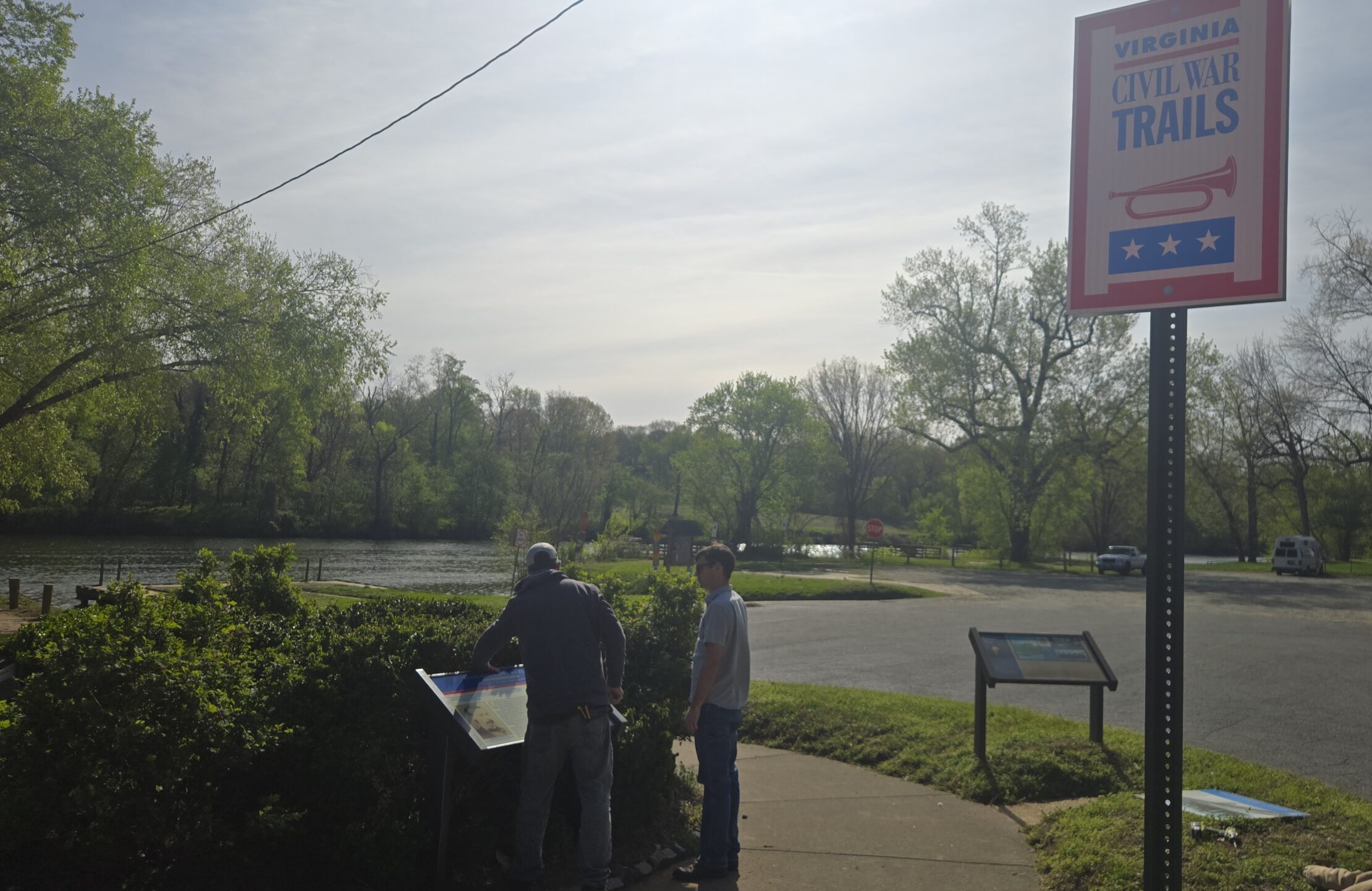
Trails team installing sign #1 on the trail at City Dock Park.


Trail Map
Click the pins to find more information about each site on the trail.
To see all 1500+ Civil War Trails sites, visit our Interactive Map.
References
O’Brien, Kevin E. (editor). My Life in the Irish Brigade: The Civil War Memoirs of Private William McCarter, 116th Pennsylvania Infantry. Savas Publishing Company, 1996.
O’Reilly, Frank Augustin. The Fredericksburg Campaign: Winter War on the Rappahannock. Louisiana State University Press, 2003.